
AI Previous Year Questions Analysis Prompt for Exam Preparation
Previous Year Questions (PYQs) are not only useful for practice. If you look at them carefully, they can also help you understand the types of questions asked in an exam, the topics that have been tested, and the areas where you need more practice.
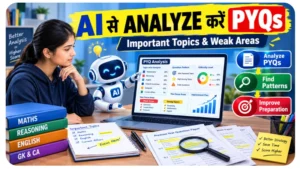
However, many students simply solve PYQs, check their answers, and move on to the next paper. They may know their score, but they do not always look at why they got certain questions wrong or whether similar concepts have appeared in different forms over the years.
This is where AI can be useful as a study assistant. Instead of asking AI to simply solve previous year questions, you can give it a set of PYQs and ask it to analyze the topics, question patterns, difficulty level, and your weak areas.
In this article, you will find a ready-to-use AI Previous Year Questions Analysis Prompt, along with practical examples of how you can use it during exam preparation.
AI Previous Year Questions Analysis Prompt
Copy the prompt below and replace the exam and subject according to your preparation:
Act as my exam preparation analyst. I am preparing for [EXAM NAME]. I will provide you with previous year questions from [SUBJECT/TOPIC]. Analyze these questions and identify the important topics, frequently tested concepts, question patterns, difficulty level, and areas I should focus on. Group similar questions together and explain what I should learn from this analysis. Do not assume that a topic will definitely appear in the next exam. Keep the analysis practical and easy to understand.
The important part of this prompt is that you are not asking AI to simply provide answers. You are asking it to look at the questions as a complete set and help you understand what the questions are telling you about your preparation.
Latest GK Test Series
What Does PYQ Analysis Actually Mean?
Suppose you have solved 100 previous year questions and got 72 correct. That score tells you how you performed, but it does not tell you everything.
Now imagine you organize those questions according to their topics. You may discover something like this:
- You are comfortable with basic Percentage questions.
- You are making repeated mistakes in Ratio and Proportion.
- You understand Time and Work formulas but struggle with application-based questions.
- You know Profit and Loss concepts but make calculation mistakes.
This is the difference between solving PYQs and analyzing PYQs.
Solving tells you how many questions you got right. Analysis can help you understand which concepts are affecting your performance.
A Practical Example: Analyzing SSC CGL PYQs
Let’s say a student is preparing for SSC CGL and has collected previous year Quantitative Aptitude questions from several papers.
After solving them, the student can use the AI prompt to organize the questions and identify common concepts.
A simplified analysis might look like this:
| Topic | Question Type | Preparation Status |
|---|---|---|
| Percentage | Basic calculation, increase and decrease | Most questions correct |
| Ratio | Direct ratio, word problems | Several mistakes |
| Time and Work | Combined work, efficiency | Concept needs revision |
| Profit and Loss | Profit percentage, discount | Calculation mistakes |
Now the student has more than just a collection of solved questions. There is a clearer idea of which areas need additional attention.
One important point should be kept in mind: PYQ analysis cannot guarantee what will appear in the next exam. Its purpose is to understand previous questions and use that information to organize your preparation more effectively.
Why Asking Only for “Important Topics” May Not Be Enough
You might simply ask an AI tool, “Tell me the important topics from these PYQs.” It may give you a useful list, but you can get a more meaningful analysis by giving it a specific task.
For example, ask it to identify questions based on the same concept, group similar questions, compare different question types, and point out areas where mistakes are common.
This changes the output from a simple list of topics into something that can actually help you decide what to revise and practice next.
Group Similar Questions by Concept
Questions from different years may look completely different while testing the same basic concept.
For example, five Percentage questions may use different numbers and wording but require a similar method to solve them.
You can ask AI to group such questions together:
Group these previous year questions according to the concept being tested. If different questions use the same underlying method, put them in the same group and explain the common concept briefly.
This can help you see how an exam can test the same concept in different ways.
Analyze the Questions You Got Wrong
This is one of the most useful ways to work with PYQs.
Knowing that an answer is wrong is only the first step. You also need to understand why the mistake happened.
For example, you may have made a mistake because:
- You did not understand the concept.
- You used the wrong formula or method.
- You made a calculation error.
- You misunderstood the question.
- You selected an answer too quickly.
If you have your working or solution steps, give them to AI along with the question and use a prompt like this:
Analyze these questions that I answered incorrectly. Identify whether my mistakes are mainly due to lack of concept, incorrect calculation, misunderstanding the question, or using the wrong method. Then tell me which concepts I should revise first.
This approach is more useful than simply looking at the correct answer because it focuses on the reason behind the mistake.
Use Your PYQs to Find Weak Areas
Every student has different weak areas. One student may understand the theory but struggle with calculations, while another may know the formula but have difficulty applying it to word problems.
That is why your own performance matters when analyzing PYQs.
You can provide your correct and incorrect answers and ask AI to identify patterns in your mistakes:
Based on my correct and incorrect answers, identify the areas where I need more practice. Separate them into conceptual weaknesses, calculation mistakes, and question-reading mistakes. Suggest what I should revise before attempting another PYQ set.
Instead of treating every wrong answer as the same type of mistake, you can start looking for patterns in your errors.
Compare Different Years or Papers
If you have PYQs from multiple years, you can also ask AI to compare them.
For example, you could ask it to identify whether the same concepts appeared in different years, whether the wording changed, and whether the difficulty level appeared different across the papers you provided.
A useful request could be:
Compare these previous year question sets. Identify concepts that appeared in more than one paper, changes in question style, and differences in difficulty. Do not predict future questions. Focus only on patterns visible in the questions I provided.
This keeps the analysis focused on the actual material instead of turning it into a prediction exercise.
Turn the Analysis into a Revision Plan
Once you know which areas need attention, you can use that information to organize your revision.
For example, if your analysis shows that Ratio and Time and Work are causing repeated mistakes, you can revise those concepts before moving to another PYQ set.
You can also ask AI to turn your analysis into a short revision checklist:
Based on this PYQ analysis, create a short revision checklist for me. Put the topics I need to revise first at the top and include the specific concepts I should practice under each topic.
This is where PYQ analysis becomes more practical. Instead of simply knowing what went wrong, you have a clearer idea of what to do next.
What Should You Do After PYQ Analysis?
Analysis is useful only when you use the information to improve your preparation.
For example, if your analysis shows that you repeatedly make mistakes in Ratio questions, simply reading the analysis will not solve the problem. You need to revise the concept and then practice similar questions.
A practical process is:
- Solve a set of previous year questions.
- Separate incorrect and doubtful questions.
- Group questions by topic or concept.
- Look for repeated mistakes.
- Revise the concepts causing problems.
- Practice new questions from those areas.
- Attempt another PYQ set later and compare your performance.
If you want to create additional practice questions from the topics you have analyzed, you can also use our AI MCQ Generator Prompt.
How to Customize the Prompt for Different Exams
The prompt is not limited to one particular exam. You can change the exam name, subject, and type of questions according to your preparation.
For example, it can be used with PYQs from:
- SSC CGL and SSC CHSL
- Railway examinations
- Banking examinations
- State-level competitive examinations
- Other entrance and recruitment tests
You can also use it for individual subjects such as Mathematics, Reasoning, English, General Awareness, Science, History, Geography, or Economics.
However, the quality of the analysis depends partly on the quality of the questions you provide. If your PYQ material is incomplete or contains incorrect questions, the resulting analysis may also be unreliable.
One Important Thing to Remember About AI and PYQs
AI can process and organize a large amount of information quickly, but it can also make mistakes. It may misunderstand a question, classify a topic incorrectly, or give an incorrect explanation.
For important exam preparation, compare the AI’s analysis with the original question paper and trusted study material. If the topic, answer, syllabus, or exam pattern is important, verify it from a reliable source before treating it as final.
Also remember that previous year questions show what was asked in the past. They do not guarantee what will be asked in the future.
Frequently Asked Questions
Can AI predict the questions that will appear in the next exam?
AI can identify patterns in the previous year questions you provide, but this does not mean it can reliably predict the exact questions or topics that will appear in the next exam. Use PYQ analysis to understand past question patterns and improve your preparation rather than treating it as a prediction method.
Can I analyze PYQs if I have only one previous year paper?
Yes. One paper can still be analyzed for topics, question types, difficulty, and concepts covered in that particular paper. However, if you have papers from multiple years, you can make broader comparisons across those papers.
Should I give the complete question paper to AI?
If the AI tool can properly handle the material, providing a complete relevant paper can be useful. For a very large collection, you may find it easier to analyze one subject or section at a time. This also allows you to focus on specific areas instead of getting a very broad response.
Can AI tell me why I got a PYQ wrong?
It can help analyze your mistake, especially when you provide your selected answer and, if possible, your solving steps. Instead of asking only for the correct answer, ask AI to identify where your method went wrong and explain the concept behind the mistake.
What should I do after finding my weak topics?
Revise the relevant concepts using your regular study material and then solve fresh questions from those areas. After some practice, attempt another PYQ set to see whether the same type of mistakes are still occurring.
Is PYQ analysis enough for exam preparation?
No. PYQs are an important part of preparation, but they should be combined with syllabus coverage, concept learning, revision, and regular practice. PYQ analysis helps you understand past questions and your own performance; it should not replace complete preparation.
Should I trust AI’s PYQ analysis completely?
No. Treat the analysis as study support rather than a final authority. Check important answers, concepts, syllabus information, and exam-related details against the original question paper and reliable study resources.
Conclusion
Previous Year Questions become more useful when you do more than simply solve them. By analyzing the questions, you can identify recurring concepts, understand different question types, find repeated mistakes, and see which areas need more practice.
An AI Previous Year Questions Analysis Prompt can make this process easier by helping you organize the questions and look at them from a preparation point of view.
Just remember that past question patterns are not a guarantee of future questions, and AI-generated analysis should be verified when the information is important. Use AI as a study assistant alongside your books, official exam information, and trusted preparation resources.
If you want more practical AI prompts for different stages of exam preparation, you can explore our AI Prompts for Students category on RojgarX.
SEO Details
SEO Title: AI Previous Year Questions Analysis Prompt for Exam Preparation
Focus Keyword: AI Previous Year Questions Analysis Prompt
Meta Description: Use this AI Previous Year Questions Analysis Prompt to analyze PYQs, find important topics, understand question patterns, identify weak areas, and improve exam preparation.
Suggested Slug: ai-previous-year-questions-analysis-prompt