
Preparing for competitive exams becomes easier when your practice is smart and well structured General Science Mock Test 1 is designed to give you a clear idea of how questions are asked in real exams helping you build confidence from the very first attempt It is not just about solving questions but about understanding concepts the right way.
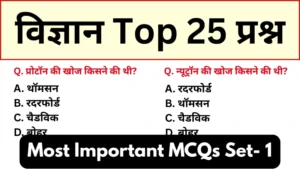
This mock test covers important topics from Physics, Chemistry and Biology that are frequently asked in SSC, RRB, MTS, GD and other competitive exams The questions are framed as per the latest exam trends keeping beginner level aspirants in mind Each section focuses on concept clarity accuracy and time management which are key to scoring better.
Whether you are starting your preparation or revising before the exam this General Science mock test works as a reliable practice tool Regular practice with such mock tests can significantly improve your performance across all competitive exams.
Latest GK Test Series
General Science Mock Test 1 for all Competitive Exams
Q. Into what type of energy do solar cells convert solar energy?
A. Heat energy
B. Mechanical energy
C. Chemical energy
D. Electrical energy
Answer: D. Electrical energy
Q. What type of image is formed on a cinema screen?
A. Virtual
B. Partial
C. Real
D. Inverted
Answer: C. Real image
Q. Which color is used in danger signals?
A. Yellow
B. Green
C. Blue
D. Red
Answer: D. Red color
Q. Kilowatt-hour is the unit of what?
A. Power
B. Energy
C. Current
D. Voltage
Answer: B. Energy
Q. What tissue is a camel’s hump made of?
A. Muscular tissue
B. Connective tissue
C. Adipose tissue
D. Nervous tissue
Answer: C. Adipose tissue
Q. Obesity is mainly caused by an excess of what?
A. Protein
B. Carbohydrates
C. Adipose tissue
D. Mineral salts
Answer: C. Adipose tissue
Q. Who discovered the proton?
A. Thomson
B. Rutherford
C. Chadwick
D. Bohr
Answer: B. Rutherford
Q. Who discovered the neutron?
A. Rutherford
B. Thomson
C. Chadwick
D. Bohr
Answer: C. Chadwick
Q. Who discovered the atomic nucleus?
A. Bohr
B. Rutherford
C. Chadwick
D. Dalton
Answer: B. Rutherford
Q. Which Indian scientist’s name is associated with a specific elementary particle?
A. Raman
B. Bose
C. Saha
D. Bhatnagar
Answer: B. Bose
Q. Which of the following atoms does not have a neutron in its nucleus?
A. Helium
B. Hydrogen
C. Oxygen
D. Nitrogen
Answer: B. Hydrogen
Q. Who first discovered the wave nature of the electron?
A. Bohr
B. Rutherford
C. De Broglie
D. Thomson
Answer: C. De Broglie
Q. Which of the following is an example of ’tissue’?
A. Heart
B. Blood
C. Liver
D. Kidney
Answer: B. Blood
Q. Where are mast cells found?
A. In muscular tissue
B. In nervous tissue
C. In epithelial tissue
D. In connective tissue
Answer: D. Connective tissue
Q. What is the filament of an electric bulb made of?
A. Copper
B. Iron
C. Aluminum
D. Tungsten
Answer: D. Tungsten
Q. What is the SI unit of resistivity?
A. Ohm
B. Ohm-meter
C. Volt
D. Ampere
Answer: B. Ohm-meter
Q. Which of the following is not used as a cooking fuel?
A. LPG
B. Biogas
C. Wood
D. CNG
Answer: D. CNG
Q. Which is the photosynthetic organelle?
A. Mitochondria
B. Ribosome
C. Chloroplast
D. Nucleus
Answer: C. Chloroplast
Q. What is the SI unit of luminous intensity?
A. Lumen
B. Lux
C. Candela
D. Watt
Answer: C. Candela
Q. When was the International System of Units (SI) implemented?
A. 1960
B. 1965
C. 1971
D. 1980
Answer: C. 1971
Q. In which of the following industries is mica used as a raw material?
A. Cloth
B. Paper
C. Electricity
D. Sugar
Answer: C. Electricity
Q. What happens to the boiling point of water when pressure is increased?
A. Decreases
B. Remains constant
C. Increases
D. Becomes zero
Answer: C. Increases
Q. “For every action, there is an equal and opposite reaction” — Which of Newton’s laws is this?
A. First law
B. Second law
C. Third law
D. Law of motion
Answer: C. Third law
Q. Who discovered radioactivity?
A. Marie Curie
B. Rutherford
C. Henri Becquerel
D. Bohr
Answer: C. Henri Becquerel
Conclusion
In conclusion, practicing with General Science Mock Test 1 helps you strengthen your basics identify weak areas and improve overall exam readiness Consistent practice not only boosts confidence but also enhances speed and accuracy Make mock tests a regular part of your preparation to achieve better scores in all competitive exams.