
If you are preparing for SSC GD, SSC MTS, RRB or any other competitive exam then strong command over History can make a big difference in your final score Many students find History confusing due to its vast syllabus and numerous facts but with the right practice it becomes one of the most scoring sections That’s why this History Questions Practice Set is designed to help you revise quickly understand concepts clearly and build real exam confidence from Day 1.
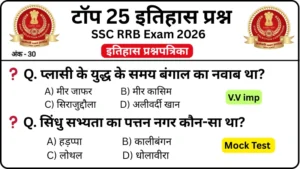
In this practice set you will find exam focused History MCQs covering Ancient Medieval and Modern Indian History along with important world history topics commonly asked in SSC and Railway exams Each question is thoughtfully structured to match the latest exam pattern making it useful not only for beginners but also for students who want smart revision With simple language clear concepts and reliable content this practice set supports your preparation journey effectively.
Whether you want to boost accuracy improve speed or strengthen your overall History preparation this History Practice Set for SSC GD, MTS, RRB and other competitive exams is the perfect study partner Stay focused practice regularly and let these questions help you move a step closer to success in your upcoming exams.
Latest GK Test Series
History Questions Practice Set: For SSC GD, MTS, RRB And all Competitive Exam
Q. Which is the oldest Veda?
A) Samaveda
B) Yajurveda
C) Atharvaveda
D) Rigveda
Answer: D) Rigveda
Q. Which was the port city of the Indus Valley Civilization?
A) Harappa
B) Kalibangan
C) Lothal
D) Dholavira
Answer: C) Lothal
Q. What material did the people of the Indus Valley Civilization use to build their houses?
A) Unbaked bricks
B) Wood
C) Stone
D) Baked bricks
Answer: D) Baked bricks
Q. Where was the Great Bath of the Indus Valley Civilization found?
A) Harappa
B) Mohenjo-daro
C) Kalibangan
D) Lothal
Answer: B) Mohenjo-daro
Q. Who reached India via the Cape of Good Hope?
A) Columbus
B) Magellan
C) Vasco da Gama
D) Albuquerque
Answer: C) Vasco da Gama
Q. Who laid the real foundation of Portuguese power in India?
A) Vasco da Gama
B) Albuquerque
C) Almeida
D) Cabral
Answer: B) Albuquerque
Q. When did the British adopt the ‘Divide and Rule’ policy?
A) After 1773
B) After 1813
C) After 1858
D) After 1909
Answer: C) After 1858
Q. Which British architect was chosen as the principal architect for the transformation of New Delhi?
A) Gandhi
B) Nehru
C) Edwin Lutyens
D) Ashley
Answer: C) Edwin Lutyens
Q. Who is the author of ‘Prem Pachisi’? A) Jaishankar Prasad
B) Nirala
C) Premchand
D) Maithilisharan Gupt
Answer: C) Premchand
Q. The judge who sentenced Bhagat Singh to death was—
A) Norman
B) Saunders
C) G.C. Hilton
D) Atkinson
Answer: C) G.C. Hilton
Q. Who was Gandhiji’s political guru?
A) Tilak
B) Gokhale
C) Nehru
D) Patel
Answer: B) Gopal Krishna Gokhale
Q. Which law was called ‘without lawyer, without argument, without appeal’?
A) Pitt’s India Act
B) Regulation Act
C) Rowlatt Act
D) Charter Act
Answer: C) Rowlatt Act
Q. Who was the Nawab of Bengal at the time of the Battle of Plassey?
A) Mir Jafar
B) Mir Qasim
C) Siraj-ud-Daulah
D) Alivardi Khan
Answer: C) Siraj-ud-Daulah
Q. In which year did the British annex Punjab to their kingdom?
A) 1845
B) 1848
C) 1849
D) 1850
Answer: C) 1849
Q. Who built the Iron Pillar near Qutub Minar?
A) Samudragupta
B) Chandragupta I
C) Chandragupta II
D) Skandagupta
Answer: C) Chandragupta II
Q. Which society was founded by Swami Dayanand Saraswati?
A) Brahmo Samaj
B) Prarthana Samaj
C) Arya Samaj
D) Ramakrishna Mission
Answer: C) Arya Samaj
Q. Who formed the ‘Danda Fauj’? A) Bhagat Singh
B) Chandrashekhar Azad
C) Chamandeep
D) Rajguru
Answer: C) Chamandeep
Q. Which country is known as the land of snakes?
A) India
B) Brazil
C) Australia
D) Africa
Answer: B) Brazil
Q. Who was the youngest revolutionary to be hanged?
A) Bhagat Singh
B) Khudiram Bose
C) Ashfaqulla
D) Rajguru
Answer: B) Khudiram Bose
Q. Who returned the title of ‘Kaiser-i-Hind’ in protest against the Jallianwala Bagh massacre?
A) Nehru
B) Patel
C) Gandhi
D) Tilak
Answer: C) Mahatma Gandhi
Q. The author of ‘Glimpses of World History’ is—
A) Gandhi
B) Nehru
C) Patel
D) Tagore
Answer: B) Jawaharlal Nehru
Q. The author of ‘The Post Office’ is—
A) Premchand
B) Nirala
C) Tagore
D) Mahadevi Verma
Answer: C) Rabindranath Tagore
Q. The author of the book ‘Kitab-ul-Hind’ is—
A) Ibn Battuta
B) Al-Biruni
C) Firdausi
D) Khusrau
Answer: B) Al-Biruni
Conclusion
In conclusion, this History Questions MCQs Quiz for SSC GD, SSC MTS, RRB and other competitive exams is a powerful way to sharpen your preparation and build exam confidence Regular practice of well structured questions not only improves accuracy but also helps you understand important historical concepts in a clear and simple manner.
With exam focused content a student friendly approach and reliable explanations this quiz supports your journey toward success in competitive exams Keep practicing stay consistent and let these History MCQs guide you toward better performance and higher scores in your upcoming CBT exams Good luck with your preparation.