
The SSC MTS (Staff Selection Commission Multi-Tasking Staff) exam is a fantastic chance for 12th-pass students to land a government job in various central government departments A key section of this exam is General Knowledge (GK) which tests your awareness of the world around you including history geography science current affairs and more To help you prepare effectively we have compiled the Top 50 Most Important SSC MTS GK Questions for the 2025 exam These questions are designed in simple English to make preparation easy and help you build confidence for the big day.
GK is a scoring section in SSC MTS if you prepare smartly These 50 questions cover high-weightage topics like Indian history important geographical facts basic science concepts and recent current events which are frequently asked in the exam Selected based on past papers and expert insights they are perfect for beginners and those looking to strengthen their knowledge By practicing these questions you will not only learn key facts but also get better at answering quickly and accurately under exam pressure.
Each question in this list is crafted to match the SSC MTS exam pattern covering a mix of easy medium and tough questions to give you a complete practice experience Whether it is remembering the capitals of states understanding scientific terms or staying updated with major events these questions will help you master the GK section They are written in a way that even students new to competitive exams can understand making revision simple and effective.
To ace the SSC MTS 2025 exam regular practice with these 50 GK questions is a must They act as a focused study tool helping you revise important topics without feeling overwhelmed Pair them with mock tests to improve your speed and check your progress With these questions you will be well-prepared to tackle the GK section and move closer to your dream of securing a government job Stay consistent and keep practicing.
Top 50 Most Important SSC MTS Questions to Crack Your 2025 Exam
Q. What is the ratio of the length and width of the Indian national flag?
(a) 2:3
(b) 3:2
(c) 4:3
(d) 5:3
Answer – (b) 3:2
Q. According to the Hindu calendar, on which day was the Indian Constitution implemented?
(a) Margashirsha Shukla Saptami, Samvat 2006 Vikrami
(b) Margashirsha Shukla Saptami, 2009 Vikrami
(c) Margashirsha Shukla Saptami, 2008 Vikrami
(d) Margashirsha Shukla Saptami, Samvat 2007 Vikrami
Answer – (a) Margashirsha Shukla Saptami, Samvat 2006 Vikrami
Q. Who was the first person in the history of science to point his telescope skyward and make a startling discovery?
(a) William
(b) Galileo Galilei
(c) Harvey
(d) Leonardo da Vinci
(d) Johannes Kepler
Answer – (b) Galileo Galilei
Q. Where does food digestion primarily occur?
(a) Large intestine
(b) Small intestine
(c) Stomach
(d) Liver
Answer – (b) Small intestine
Q. When was the Eighth Five-Year Plan implemented?
(a) 1987
(b) 1990
(c) 1992
(d) 1995
Answer – (c) 1992
Q. What is the refraction of light responsible for?
(a) Twinkling of stars
(b) Blue color of the sky
(c) Rainbow
(d) Formation of shadows
Answer – (a) Twinkling of stars
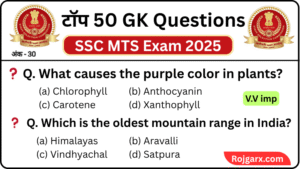
Q. What causes the purple color in plants?
(a) Chlorophyll
(b) Anthocyanin
(c) Carotene
(d) Xanthophyll
Answer – (b) Anthocyanin
Q. Who has the authority to declare a state of emergency?
(a) President
(b) Prime Minister
(c) Rajya Sabha
(d) Lok Sabha
Answer – (a) President
Q. Which is the oldest mountain range in India?
(a) Himalayas
(b) Aravalli
(c) Vindhyachal
(d) Satpura
Answer – (b) Aravalli
Q. Who was the founder of Belur Math?
(a) Ramakrishna Paramahamsa
(b) Swami Vivekananda
(c) Dayanand Saraswati
(d) Mahatma Gandhi
Answer – (b) Swami Vivekananda
Q. What was the name of India’s first satellite?
(a) INSAT
(b) APPLE
(c) Aryabhatta
(d) Bhaskara
Answer – (c) Aryabhatta
Q. What is the full form of ITDC?
(a) Indian Tourism Development Corporation
(b) Indian Trade Development Corporation
(c) International Tourist Department Corporation
(d) Indian Technical Development Corporation
Answer – (a) Indian Tourism Development Corporation
Q. What is the minimum distance of clear vision for a normal, healthy human eye?
(a) 10 cm
(b) 15 cm
(c) 20 cm
(d) 25 cm
Answer – (d) 25 cm
Q. Where and when was the first metro train introduced in India?
(a) Bombay on January 26, 1950
(b) Delhi on August 15, 1947
(c) Kolkata on October 24, 1984
(d) Bangalore on October 2, 1945
Answer – (c) Kolkata on October 24, 1984
Q. When was the Planning Commission formed?
(a) 1947
(b) 1950
(c) 1957
(d) 1962
Answer – (b) 1950
Q. Which of the following rivers flows from south to north?
(a) Krishna
(b) Son
(c) Kaveri
(d) Godavari
Answer – (b) Son
Q. Where is the atomic weight of an element expressed?
(a) NPL
(b) AMU
(c) SI
(d) GM
Answer – (b) AMU
Q. Who was the first Mongol ruler to invade India?
(a) Timur
(b) Genghis Khan
(c) Hulagu
(d) Babur
Answer – (b) Genghis Khan
Q. Who is the author of the novel ‘Godaan’?
(a) Sumitranandan Pant
(b) Munshi Premchand
(c) Kabir Das
(d) Bhavabhuti
Answer – (b) Munshi Premchand
Q. Which High Court does the Goa High Court fall under?
(a) Bombay High Court
(b) Delhi High Court
(c) Madras High Court
(d) Patna High Court
Answer – (a) Bombay High Court
Q. Which disease is caused by a deficiency of Vitamin B in the human body?
(a) Night blindness
(b) Beriberi
(c) Scurvy
(d) Anemia
Answer – (b) Beriberi
Q. Where did Mahatma Gandhi launch the Salt Satyagraha?
(a) Dandi
(b) Sevagram
(c) Sabarmati
(d) Paunar
Answer – (c) Sabarmati
Q. When and where was Akbar born?
a. October 15, 1542, Fatehpur Sikri
b. October 15, 1542, Amarkot
c. November 14, 1540, Delhi
d. August 15, 1542, Agra
Correct answer: b. October 15, 1542, Amarkot
Q. When was ‘Jana Gana Mana’ adopted as the national anthem of India?
a. January 26, 1950
b. January 24, 1950
c. 15 August 1947
d. 27 December 1911
Correct Answer: b. 24 January 1950
Q. India’s national anthem, ‘Jana Gana Mana’, was first sung at the ______ session of the Indian National Congress.
a. Calcutta
b. Tripuri
c. Lahore
d. Belgaum
Correct Answer: a. Calcutta
Q. Who was the first Muslim President of the Indian National Congress?
a. Badruddin Tyabji
b. Abul Kalam Azad
c. Syed Ahmed Khan
d. Mohammad Ali Jinnah
Correct Answer: a. Badruddin Tyabji (1887, Madras)
Q. Who built the Iron Pillar of Delhi?
a. Ashoka
b. Chandragupta II
c. Samudragupta
d. Harshvardhan
Correct Answer: b. Chandragupta II
Q. Which revolutionary of the Kakori case was hanged in Gorakhpur jail?
a. Rajendranath Lahiri
b. Ashfaqulla Khan
c. Ram Prasad Bismil
d. Roshan Singh
Correct Answer: c. Ram Prasad Bismil
Q. In which season are Kharif crops grown?
a. Autumn
b. Monsoon
c. Spring
d. Autumn
Correct Answer: b. Monsoon
Q. When was independent India’s first industrial policy announced?
a. 1947
b. 1948
c. 1950
d. 1951
Correct Answer: b. 1948
Q. Which is India’s largest mineral-producing state?
a. Karnataka
b. Jharkhand
c. Bihar
d. West Bengal
Correct Answer: b. Jharkhand
Q. What was the name of Chandragupta I’s wife, who was a princess of the Lichchavi Republic?
a. Kumardevi
b. Laxmi Devi
c. Durgavati
d. Padmavati
Correct answer: a. Kumardevi
Q. Who was the litterateur called ‘Indian Soul’?
a. Premchand
b. Mahadevi Verma
c. Suryakant Tripathi Nirala
d. Makhanlal Chaturvedi
Correct answer: d. Makhanlal Chaturvedi
Conclusion
With these Top 50 Most Important SSC MTS GK Questions you now have a powerful tool to excel in the 2025 exam Make a daily habit of practicing these questions to strengthen your knowledge and improve your speed Combine them with mock tests and stay updated on current affairs to ensure you are fully prepared Keep a positive mindset manage your time well and stay focused on your goal You are just a few steps away from achieving success.